

Few things can rival the charisma and overwhelming might of the axe! Once a fearsome weapon capable of splitting shields—and the warriors behind them—today it serves mostly as a practical and reliable tool. But over the millennia, those who owns axes have accumulated a fair share of myths and legends. Let’s waste no time and start debunking them!
How Myths Affect Tool Choice and Safety
Humans simply can’t live without myths, mysticism, and a bit of shizoterica — even if, at times, it plays a cruel trick on them. And this case is no exception. It often leads them to choose the wrong tool, use it incorrectly, or neglect its upkeep. These errors may seem minor at first, but they can result in poor performance, personal injury, or shortened tool lifespan.
Choosing the Wrong Axe Due to Misconceptions
One of the most common myths is that any axe can do any job. People often assume all axes are more or less the same—but this couldn’t be further from the truth. Different tasks require different designs. For example:
- A splitting maul is designed for driving force straight down into wood fibers.
- A felling axe is shaped to cut across the grain and down trees efficiently.
- A hatchet is axe for cutting, light work and kindling, but dangerous to use for heavy chopping.
Another myth is that “bigger is better.” Some users believe a large, heavy axe is always more effective, but this can lead to fatigue and loss of control—especially for beginners. Choosing the right axe for your body size, strength, and intended purpose is far more important than size alone.
Finally, many assume that inexpensive or generic axes are “just as good” as quality tools. In reality, low-grade steel and poor craftsmanship can result in blades that dull quickly, handles that break easily, and an overall unpleasant experience.
 Risks of Improper Use from Lack of Knowledge
You’d think it’s just an axe — no special skills or techniques needed. Just swing wide and smash into the wood with all your might! Unfortunately, it’s not that simple. Misusing an axe can lead to more trouble than you’d expect. Here are just a few things that can go wrong:
- Kickback from striking wood at the wrong angle.
- Lacerations from poor grip or mishandling during a swing.
- Foot injuries when an axe glances off the target or misses completely, leaving you missing part of your leg.
There’s also a persistent belief that protective gear is unnecessary. In truth, gloves, boots with reinforced toes, and even eye protection can prevent serious injuries—especially for beginners or when working in rough terrain. Learning proper technique—stance, grip, swing motion, and how to read the grain of the wood—can make your work safer, faster, and more efficient.
Improper or Neglected Axe Maintenance
Many also believe that an axe doesn’t require regular maintenance — chop some wood, toss it in the shed, and that’s it! But with that kind of neglect, your tool will quickly turn into nothing more than a useless piece of scrap metal.
Let’s break down a few common myths:
- “A dull axe is safer than a sharp one.” False. A dull blade requires more force, which increases the chances of losing control. A sharp axe bites cleanly into wood, reducing bounce and glancing blows.
- “Axes don’t need to be cleaned or oiled.” Wrong. Exposure to moisture causes rust on the head and rot in the handle. Regular axe handle care, with oiling (of both the blade and wooden handle) keeps the tool in good condition.
Regularly sharpen your axe, oil the blade, and check it for chips — and you’ll be rewarded. With proper care, your axe can last for centuries.
 The Most Popular Myths About Axes
Myth 1. Axes Can’t Be Compact or Portable
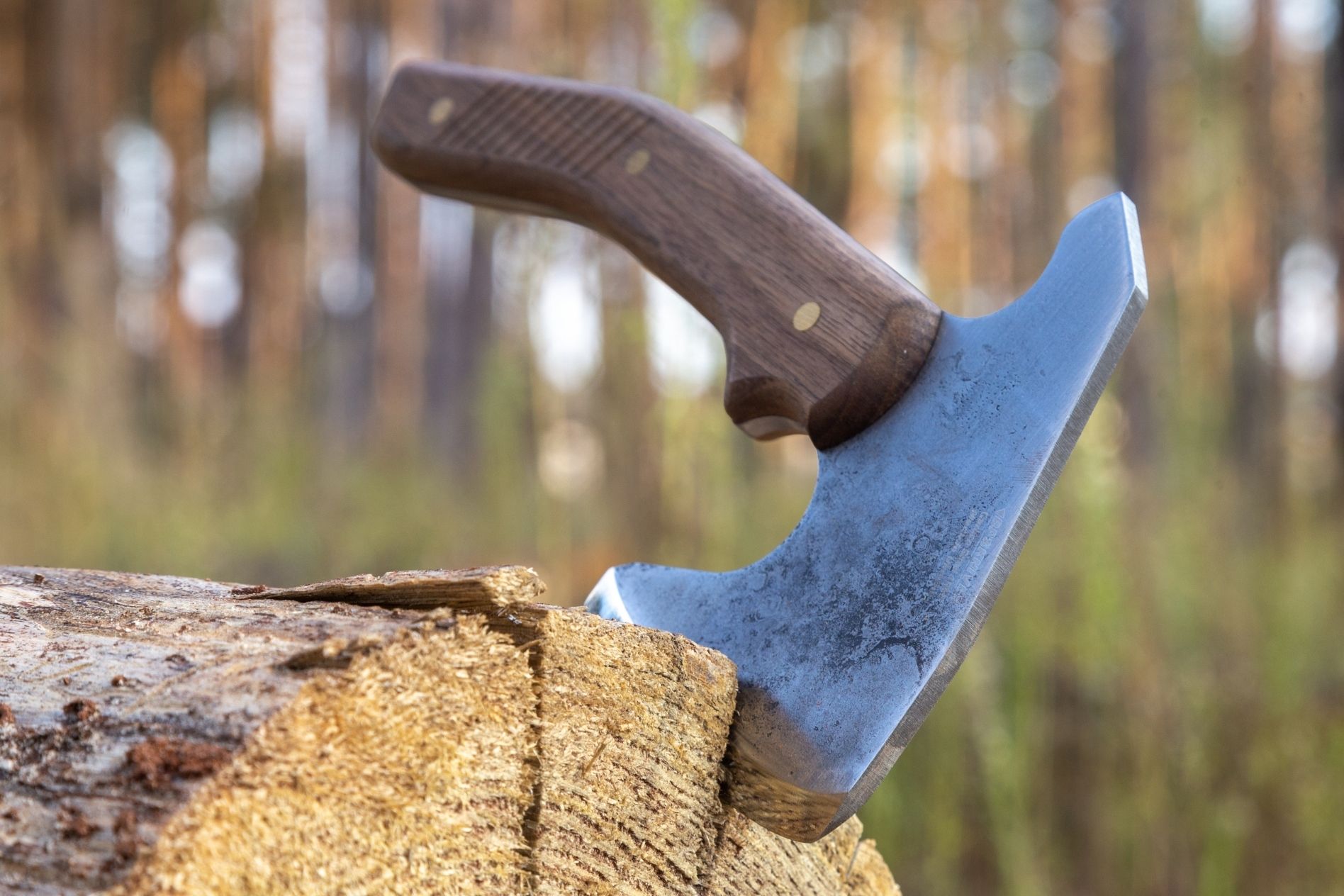
And here’s another common misconception we’ve personally busted! Our craftsmen have created one of the most compact and stylish axes on the planet — the [BUSH AXE]. Measuring just 24 cm in length, it’s about the size of two fists! The blade is forged from high-quality 1066 carbon steel, while the handle is made from walnut wood. Plus, it comes with our signature genuine leather sheath! This mini axe is perfect for camping, hiking, or any outdoor adventure where you might need to chop firewood, branches, or even cut meat with bones for your barbecue. A true must-have. Truly one of the best small camping axe!
Myth 2. The Bigger the Axe, the Better It Is for Any Task
Long-forgotten instincts — which, nevertheless, never truly left us — confidently urge us to ‘grab a bigger club!’ But an axe isn’t a club, and it doesn’t always have to be big, though it’s true that a heavier axe can generate more force. Bigger doesn’t always mean better—especially if it compromises control, accuracy, or safety! A heavy felling axe may be perfect for taking down a tree, but it’s overkill for splitting kindling or shaping wood. Likewise, using a large axe when a hatchet would suffice can lead to fatigue and even injury. Choosing the right axe for the right task—based on size, head weight, axe handle design and length, and intended use and care of axe —is what really determines how effective and safe it will be.
Myth 3. All Axes Are the Same, Only the Design Differs
This is one of the most common myths! Sure, you could say that all axes share a basic form — a handle and a head — but that’s where the similarity ends. Beyond that, axes are highly specialized tools, varying in size, weight, design, and purpose:
- Splitting axes have thick, wedge-shaped heads for forcing logs apart.
- Felling axes are narrower and sharper, built to slice across grain.
- Carving axes have finer control and more curved edges.
- Tactical or throwing axes are built for balance, not heavy chopping.
Even within one category, quality can vary enormously. A cheap camp axe and a high-end axe for bushcraft may look similar but perform very differently due to material quality and craftsmanship. Understanding these distinctions helps you choose a tool that truly fits your needs—rather than relying on appearance alone.
 Conclusion
And now, having dispelled all that darkness of ignorance with the dazzling light of truth, it’s time to get yourself an axe! Where, you ask? Well, you already know — in our awesome online store. There you’ll find the best axe for camping, knives, accessories, and pretty much everything you could need for camping, hiking, and survival! So gear up and head out — adventure awaits! Until next time.