
It happens that you meet a girl, there’s an instant spark between you, everything is developing perfectly, and she agrees to come over to your place for dinner. You need to hurry — she’ll be there in two hours, so you have to chop salads, cut fruit, and prepare the dishes in time!
You start cutting a tomato, but the knife slips, and instead of having a delicious dinner, you end up with a cut hand and spend your evening at the hospital. Why did this happen? Because knives need to be regularly sharpened!
Understanding Sharpness
Knife sharpness refers to the edge’s ability to cut through materials with minimal force. A sharp knife has a fine, precise edge that slices through objects cleanly, whereas a dull knife tends to crush, tear, or squish the material, leading to less efficient and more dangerous cuts. Sharpness is not just about how fine the edge is, but also how well it maintains its ability to cut with minimal effort.

Why Sharpness Matters
Efficiency:
- Clean Cuts: A sharp knife will slice through food more easily, making prep work quicker and requiring less force. This is particularly important when preparing delicate ingredients like tomatoes, herbs, or fish, where a clean cut preserves texture and presentation. Testing knife sharpness regularly will help to keep your blade ready to use.
- Safety: While it may seem counterintuitive, sharp knives are safer than dull ones. With a sharp knife, you can make controlled, precise cuts, reducing the likelihood of slipping and cutting yourself. A dull knife, on the other hand, can easily slip off the material you’re cutting, causing accidents.
Food Quality:
- Preservation of Integrity: Sharp knives help to maintain the texture and structure of food. For example, a dull knife can crush delicate vegetables or fruit, bruising the flesh, while a sharp knife will cut cleanly without altering the texture.
- Flavor: When cutting herbs, a sharp knife minimizes cell damage, preserving their natural oils and flavor. A dull knife may bruise herbs, causing them to lose flavor and aroma.
Precision:
- Uniformity: A sharp edge allows for more uniform cuts, which is essential for consistent cooking, especially in professional settings. Even, precise slices ensure that all pieces cook evenly, improving overall dish quality.
Ease of Use:
- Less Force: With a sharp knife, you don’t have to apply as much force to make a cut. This means less fatigue during long prep sessions and more control over your cutting motion.
Common Misconceptions About Sharpness
- You Only Need to Sharpen a Knife When It’s Dull! Knives don’t only get dull when they can’t cut at all. Regular honing (aligning the edge) helps maintain sharpness. You can often hone a knife to restore its cutting performance without needing to go through a full sharpening process. Over-sharpening can also wear down the blade prematurely, so regular honing is key to prolonging the knife’s life.
- A Very Sharp Knife Will Cut Through Anything Easily! While a sharp knife is great for cutting through many materials, there are limits. For example, a very sharp knife with a thin edge may struggle with very hard materials like bones or frozen foods, as the edge can chip or dull faster. It’s important to match the knife to the task—precision knives for soft or delicate materials and more robust knives for tougher jobs.
- Dull Knives Are Just as Safe as Sharp Ones! As mentioned earlier, dull knives are actually more dangerous because they require more force to cut. This increases the chances of slippage or a lack of control, which can lead to injury. A dull knife often slips off the material being cut, leading to accidents.
- You Can Sharpen Any Knife with Any Tool! Not all knives should be sharpened with the same tools. While honing rods are good for maintaining an edge, they don’t truly sharpen a knife. Similarly, sharpening stones or electric sharpeners can be used, but the type of steel and edge angle of the knife determines what sharpening method is best. For example, a Japanese knife with a harder steel requires finer grit stones for sharpening.
- Expensive Knives Are Always Sharper! While high-quality knives often hold their edge longer and can be sharpened to a finer angle, they’re not inherently sharper out of the box. The sharpness of a knife is more about its edge geometry, grind, and finishing than its price tag. A well-maintained, mid-range knife can outperform an expensive one that has been poorly maintained.
- A Knife Is Only as Sharp as Its Edge! Sharpness is a combination of the edge and the maintenance of the blade’s structure. A high-quality steel will hold its edge longer, and a knife with a good edge geometry will remain sharp longer. Simply sharpening a knife doesn’t guarantee performance if the blade material or the edge alignment is poor.

How to test sharpness of a blade
Great! And how can you check the sharpness of a blade? Any testing knife sharpness methods?
Paper Cutting Test
Take a piece of regular printer paper or newspaper, hold it taut, and attempt to slice through it. A sharp knife will cut through the paper smoothly, with little to no resistance. A dull knife will tear the paper or struggle to slice through it. Solid test knife sharpness method.
Hair Shaving Test
Gently try to shave a small patch of hair from your forearm. A sharp knife will cut through the hair easily with minimal pressure. A dull knife may either fail to shave hair or require more force, and it might feel “grabby” on the skin. One of the best knife sharpness tests!
Tomato Slice Test
Next blade sharpness test is that you hold a ripe tomato (or any soft fruit with a smooth skin) in one hand and try slicing through it without crushing it. A sharp knife should cut through the skin of the tomato effortlessly without squashing the fruit. A dull knife will often crush the tomato before it can make a clean cut.
Fingertip Test
Another nice “how to test knife sharpness” idea! A common method to test a knife’s sharpness is to gently run a fingertip along the cutting edge (not across it). When doing this, a sharp knife will slightly catch on the skin, indicating its effectiveness in cutting, while a dull blade will feel smooth as it glides over the skin without resistance.
Always prioritize safety and consider using other non-contact sharpness tests if you’re unsure.
Maintaining Knife Sharpness
Maintaining knife sharpness is essential for safety, efficiency, and ease of use in the kitchen. Regular sharpening and honing, as well as proper storage, are key to ensuring your knives remain in optimal condition.
Regular Sharpening and Honing
Sharpening and honing are two distinct processes, each important for maintaining a knife’s edge.
Honing (Routine Maintenance)
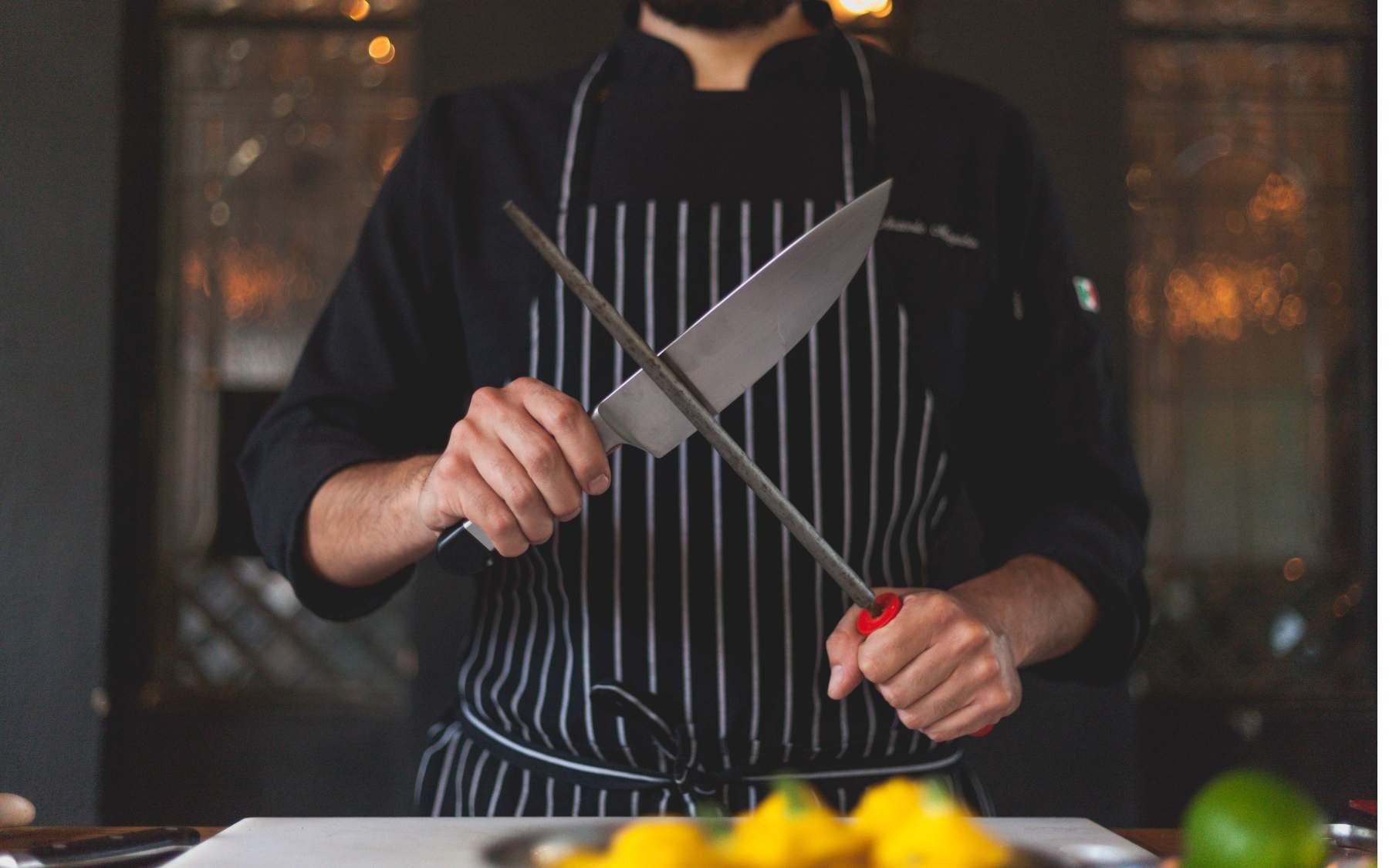
Purpose: Honing realigns the microscopic edge of the blade that gets bent during use. It doesn’t remove significant material but keeps the knife sharp for longer.
How to Hone:
- Honing Rod: Use a honing rod (typically made of steel or ceramic) to maintain the blade’s edge. Hold the knife at a 15–20 degree angle and gently swipe the blade along the rod, alternating sides. Perform this 5–10 times per side.
- Frequency: Honing should be done regularly, ideally before or after each use.
Sharpening (Restoring the Edge)
Purpose: Sharpening removes material from the blade to restore its edge when it becomes dull or damaged. Over time, honing alone will not suffice, and sharpening is necessary.
How to Sharpen:
Whetstone: A high-quality whetstone is one of the best tools for sharpening. You’ll want to use a coarse grit (around 1000) for dull knives and a finer grit (3000-8000) for honing the edge once it’s been restored.
- Soak the stone in water for 10-15 minutes before use.
- Hold the knife at a 15-20 degree angle and slide the blade across the stone in a sweeping motion, alternating sides.
Electric Sharpener: If you’re not comfortable using a whetstone, an electric sharpener can do the job. However, it can be less precise and may remove more material than necessary.
Frequency: Sharpening should be done every 3-6 months, depending on how often the knife is used and the type of knife.

When to Sharpen or Hone?
- Honing should be done every few uses, or even before every meal prep.
- Sharpening is needed when honing doesn’t restore the edge (if you notice the knife is struggling to cut cleanly or has nicks in the blade).
Proper Knife Storage
The proper storage of knives most effectively prevents them from dulling. A knife block is a common and convenient storage option. It keeps the blades separated, preventing them from rubbing against other utensils and losing their edge. Make sure the block has slots for the full range of knives you use.
A magnetic strip mounted on a wall or inside a drawer is an excellent way to store knives. It keeps them easily accessible and prevents them from touching other utensils, which can cause damage to the edges.
A drawer insert designed for knives keeps them organized and separated. It’s a good option if you prefer to store knives out of sight but still need easy access.
For those with high-end knives or who need to transport knives (e.g., chefs), a knife roll or case provides safe storage. The padded compartments prevent the knives from making contact with one another.
Never store knives in the sink with dishes or loose in drawers where they can rub against other objects, dulling the blade or causing damage. This can also be a safety hazard. Don’t forget regular knife tests for sharpness.
Additional Tips for Knife Care
- Use the Right Cutting Surface: Always use a cutting board made of wood, bamboo, or plastic. Avoid cutting on hard surfaces like glass, granite, or ceramic, which can damage the knife’s edge.
- Avoid Dishwashers: Dishwashers can cause the knife’s edge to dull and may lead to rusting, as well as damaging the handle or blade. Always wash knives by hand with warm water and dry them immediately.
- Use Knives for Their Intended Purpose: Using a knife for tasks it wasn’t designed for (like prying open cans) can cause damage to the blade.
Conclusion
Regularly sharpen your knife, keep an eye on its sharpness, and store it properly. In the kitchen, a well-maintained blade ensures efficiency and safety. Then, in a moment of need, your knife will help you overcome any obstacles in your culinary tasks. Ta-ta.