

Everything is clear with ordinary shaped blades, more or less! Here’s a huge Bowie knife, here’s a ravenously curved kukri, and here we have an Eskimo ulu. But what’s this toothy, saw-like thing?
Overview of serrated knives and their unique design
And these are the famous serrated knives – the perfect blades for all kinds of adventures! Because of this unique edge shape, this knife is perfect for slicing anything. Meat, rope, wood, they can do it all! But remember to keep your fingers away from the edge during cutting.
Understanding Serrated Blades
Now with more details! What serrated meaning, design, functionality etc.

Design and Functionality
The defining feature of a serrated knife is its jagged, tooth-like edge. This design is inspired by the teeth of a saw and provides multiple points of contact with the material being cut. Serrations come in various patterns, including single-bevel serrations (one side of the blade is sharpened) and double-bevel serrations (both sides are sharpened), each affecting how the blade cuts. Common serration patterns include wave-shaped, scalloped, or saw-like teeth, which allow for more efficient cutting through tough or fibrous materials. This is what does serrated mean!
Blade Material:
- Outdoor serrated knives are typically made from high-carbon stainless steel or tool steel for a balance between strength, sharpness retention, and corrosion resistance. High-quality steel improves durability, which is essential when working in harsh outdoor environments.
- Some knives feature ceramic coatings or other treatments that make the blade more resistant to rust, which is especially important when exposed to moisture or wet conditions.
Handle:
- Outdoor knives, including offset serrated knife, come with handles designed for comfort, control, and durability. Common materials for the handle include rubber, G10 composite, or micarta, which offer excellent grip even in wet conditions. Handles may also feature ergonomic designs, such as contoured shapes or textured surfaces, to reduce hand fatigue during prolonged use.
Blade Length:
- Serrated knives vary in size, but most outdoor models are designed with a medium-length blade (typically between 4 to 7 inches). This length provides a balance between ease of handling and the ability to cut larger materials effectively.
- Compact models are more portable for backpacking, while longer blades might be favored for heavy-duty tasks such as cutting large logs or branches.
Full Tang Construction:
- Many serrated knives used in the outdoors are constructed with a full tang, meaning the blade runs the full length of the handle. This increases the strength and durability of the knife, making it less likely to break or bend under stress.
Comparison with Straight-Edged Blades
Both serrated blades and straight-edged blades have distinct advantages and drawbacks, making them suitable for different purposes!
Serrated knives are ideal for tough, fibrous materials and wet conditions. They’re durable, require less maintenance, and excel in outdoor environments, particularly for survival or emergency tasks. However, they’re less effective for precision work. Besides, you must know how to sharpen serrated knives, it is not the easiest procedure.
Straight-edged knives, on the other hand, are better for tasks that require precision, control, and a clean cut. They’re perfect for detailed work in food preparation or other tasks that demand accuracy. However, they need more frequent sharpening and can be less effective on tougher materials.
In an outdoor setting, the best option is a combination of both: a serrated knife for general utility and tough cutting tasks, paired with a straight-edged knife for tasks requiring clean, fine cuts.
Legendary Serrated Knives
And of course among these knives are many that have become iconic:
Iconic Models and Their History
Spyderco Endura (with Serrated Edge)
Introduced in the 1990s, a small serrated knife Spyderco Endura quickly became a favorite among outdoor enthusiasts. Known for its ergonomics, reliable locking mechanism, and high-performance steel, the Endura’s serrated version gained a strong following.
The Endura with a fully serrated edge is ideal for cutting through thick ropes and fibrous materials. It features a lightweight design, molded fiberglass-reinforced nylon handle, and a VG-10 or ZDP-189 steel blade. Its signature Spyderco thumb hole allows for one-handed opening.
 Photo from ebay.com
Cold Steel Recon 1 (Serrated)
The Cold Steel Recon 1 was designed as a tough tactical knife with a reputation for durability. First released in the early 2000s, it became popular among military and law enforcement.
The Recon 1’s serrated version is excellent for utility tasks in extreme conditions. It’s built with Cold Steel’s Tri-Ad lock for a secure and safe blade, a deeply serrated edge for efficient cutting, and a grippy G-10 handle for optimal control.
 Photo from amazon.com
Gerber StrongArm (Serrated)
The Gerber StrongArm is a highly regarded fixed-blade knife, first introduced in 2015, with a rugged, military-inspired design. It’s especially popular in survival and tactical circles.
The StrongArm serrated model is known for its versatility and sturdiness. The serrated edge helps with cutting through tough materials, and the full tang construction ensures strength. The rubberized handle provides a comfortable and secure grip, and the versatile sheath allows for various carry options.
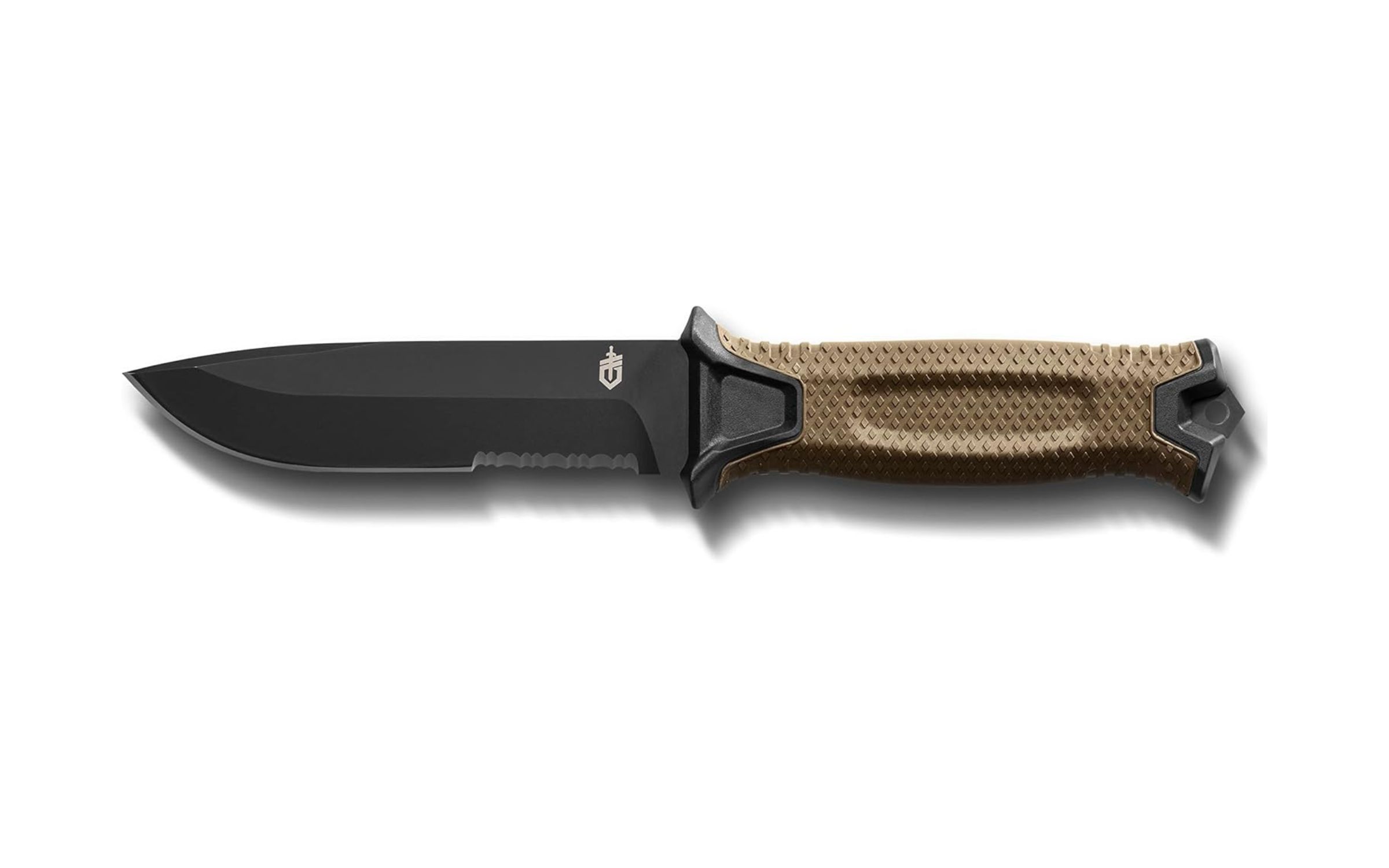 Photo from amazon.com
Benchmade Griptilian (Serrated)
Benchmade has built a reputation for making high-quality knives for outdoor and tactical use. The Griptilian, first released in 2001, is a favorite due to its versatile design and robust performance.
The serrated version of the Griptilian features an ergonomic handle made from textured nylon, providing a solid grip. Its 154CM steel blade offers great edge retention and the partially serrated edge makes it versatile for cutting through various materials like paracord, fabric, and food.
 Photo from knivesandtools.ie
Ka-Bar USMC Fighting/Utility Knife (Serrated)
The Ka-Bar fighting knife became legendary during WWII and continues to be a symbol of American military toughness. The serrated version was introduced to offer versatility, especially for cutting tasks in combat and survival.
The Ka-Bar serrated knife has a robust fixed blade, typically made of 1095 Cro-Van steel. Its handle is made of leather or Kraton for a firm, non-slip grip. The serrated portion on the blade adds an edge for cutting through tough materials like seat belts, rope, or heavy fabric.
 Photo from houseofknives.ca
Common Features of Legendary Serrated Knives
Serration Patterns
Serrated knives feature different patterns of serrations, each optimized for specific tasks:
- Half-Serrated: A combination of a straight edge and serrations, often preferred for general outdoor tasks. The straight portion is used for precision cuts, while the serrated section excels at cutting tough materials.
- Fully Serrated: A knife where the entire edge is serrated. These are typically better for cutting through fibrous materials, rope, and wet or crusty substances. They work well for aggressive cutting tasks.
- Double-Serrated: Some knives have double serrations, offering sharper, deeper cuts with increased efficiency.
Locking Mechanisms
- Secure Locking: For folding serrated knives, secure locking mechanisms are essential. Popular locks include Spyderco’s Lockback and Benchmade’s AXIS Lock, both of which prevent the blade from accidentally closing during use.
- Full-Tang Construction: Many iconic serrated knives, especially fixed-blade models, feature full-tang construction, meaning the blade extends through the handle, providing strength and durability.
Versatility
- Serrated knives are known for their versatility in the outdoors. The serrations can easily slice through materials that a plain edge would struggle with, like rope, cloth, or food items (e.g., crusty bread, meat with bones, or hard-skinned fruits).
- Multi-Tasking: A serrated blade can handle a variety of tasks, from prepping food in a camping environment to cutting through dense vegetation or materials in a survival scenario.
Corrosion Resistance
- Outdoor knives must withstand various elements, including moisture. Many legendary serrated knives use corrosion-resistant materials or coatings like Cerakote or Black Oxide to protect the blade from rusting.
Compact and Lightweight Design
- Many serrated knives, especially folding models, are designed to be lightweight and portable, making serrated knife uses ideal for carry at outdoor activities like backpacking, fishing, and hiking.
Conclusion
Serrated knives have most emphatically and deservedly earned their place in the knife industry! It is hard to find a more suitable knife for camping or hiking in harsh conditions. However, the best option is to bring along a knife with both a straight blade and a serrated blade, sometimes you need a blade for precise, jewellery work after all! See ya!