
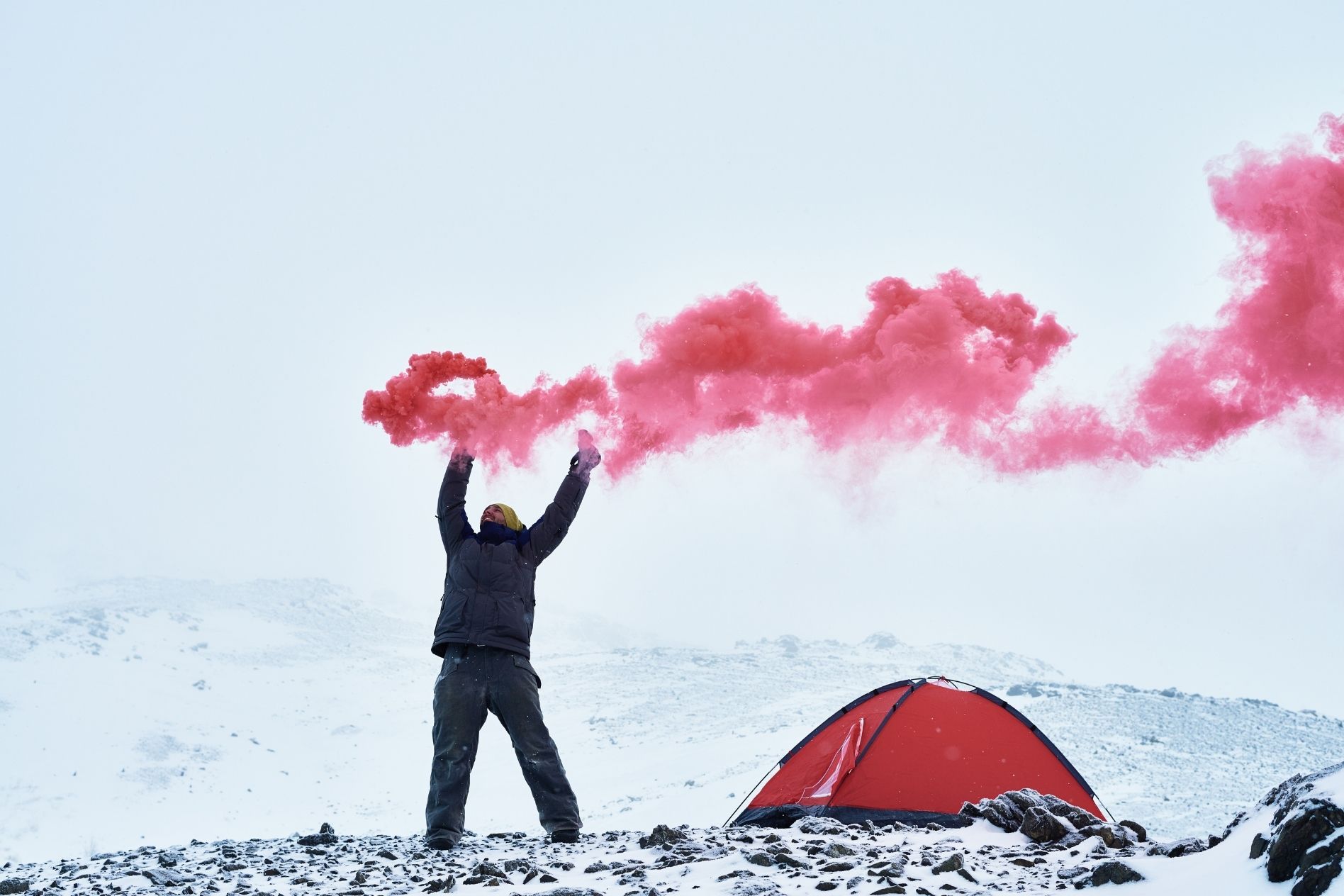
Sometimes life throws you into the middle of nowhere—a truly remote and harsh wild nature. And not just casually, it hits you full force, with all the extra pleasures included: no connection, no water, no food, just wild nature surrounding you, full of creatures whose only dream is to have you for lunch. And of course, the weather doesn’t make it any easier: one moment the sun is blazing hot, melting your brain, the next a torrential downpour hits like you’ve decided to take a swim in hell itself. Oh, and dysentery for dessert! So, what do you do?
Classic SOS signals – who invented the SOS signal
Of course, it wouldn’t hurt to sign up for the nearest survival course right now, so you’re ready for any extreme situation! But there’s something else you need to know: how to send SOS signals. What does the SOS signal do in the forest? It is internationally recognized distress calls designed to attract attention and request help as efficiently as possible. Before the era of modern radios and GPS devices, people relied on visual and auditory signals to call for help. The most famous of these is the SOS signal, which became the global standard for distress communication in the early 20th century. It was simple, unmistakable, and easy to transmit using Morse code, lights, or even sound. What was the distress signal before SOS? The most common were:
- CQD – Introduced by the Marconi Company in 1904, it was one of the earliest widely recognized radio distress signals.
○ C = “All stations”
○ Q = “Query” (used in radio communications)
○ D = “Distress”
So together, CQD essentially meant “All stations: distress!”
- Visual Signals – Before radio, distress was indicated by flags, lights, or other visual cues:
○ Flag N over C (from the International Code of Signals)
○ Firing guns at intervals
○ Flares or rockets
Definition of SOS signal
So, what is the SOS light signal? The SOS code (· · · — — — · · ·) was officially adopted by the International Radiotelegraphic Convention in 1906 and went into effect in 1908. Contrary to popular belief, SOS doesn’t stand for any specific words like “Save Our Souls” or “Save Our Ship.” The sequence was chosen purely because it is easy to recognize in Morse code and unlikely to be mistaken for another help signal.
International rules for signaling
Today, SOS remains the universal distress signal under international law. The International Telecommunication Union (ITU) and maritime regulations specify how it can be used in various forms—radio, light, or sound. How to send SOS signals, for example:
- Morse code: · · · — — — · · ·
- Visual signals: Three short flashes, three long flashes, three short flashes
- Audible signals: Three short sounds, three long sounds, three short sounds
- Ground signals (for air rescue): Large SOS markings or three symbols visible from above
Modern devices like EPIRBs (Emergency Position-Indicating Radio Beacons) and PLBs (Personal Locator Beacons) transmit automated SOS signals via satellites, instantly alerting rescue teams worldwide.

Visual SOS signals
Visual SOS signals are among the most effective ways to attract rescuers’ attention, especially in daylight or when you have no radio equipment. These signals can be created with reflective surfaces, fire, smoke, or by marking the ground in a way visible from the air.
Mirror, foil or polished knife
A small reflective object—such as a mirror, piece of metal foil, or even a polished knife blade—can become a powerful signaling tool. By reflecting sunlight toward an aircraft, ship, or search party, you can send flashes visible from many kilometers away.
To use it effectively:
- Hold the mirror near your eye and aim the reflection at the target.
- Sweep the light back and forth to ensure visibility.
- Use a series of three flashes to indicate distress (repeating the SOS pattern if possible).

Smoke or fire signals
Fire has always been a classic method of signaling for help. During the day, thick white or colored smoke attracts attention; at night, bright flames serve the same purpose.
To maximize visibility:
- Build three fires in a straight line or triangle—this is the international distress pattern.
- Use green branches, rubber, or damp leaves to create dense smoke.
- Maintain control to prevent accidental wildfires.
SOS inscription or large symbols on the ground
When rescuers are searching from the air, large symbols on open ground are one of the most effective ways to communicate distress.
Tips:
- Use stones, logs, clothing, or contrasting materials to form letters or shapes.
- The classic SOS symbol or “X” (meaning “need help”) should be at least 3 meters high for visibility from the air.
- If possible, mark the area around the sign with bright colors or reflectors.

Using light sources at night
At night, flashlights, headlamps, or even a mobile phone screen can serve as lifesaving signaling devices.
- Use three short, three long, three short flashes to represent SOS in Morse code.
- Repeat the signal periodically to catch attention.
- Avoid continuous light—it’s less noticeable than rhythmic flashes.

Audible SOS signals
When visibility is low—at night, in fog, dense forest, or underground—sound becomes the most effective way to attract attention. Audible SOS signals are easy to produce using simple objects or even your own voice, and they can carry over great distances depending on the environment.
Whistle or metal object
A whistle is one of the most efficient emergency tools. It requires little effort and can be heard much farther than shouting.
- Use three short blasts, three long, three short to form the SOS rhythm.
- If you don’t have a whistle, strike a metal object—like a pot, knife, or piece of gear—against another hard surface to create a clear, sharp sound.
- Repeat the pattern regularly, leaving pauses so rescuers can locate the source.
Screams, blows, knocks
If you have no tools, you can still send SOS by using your voice or improvised sounds.
- Shout in a clear, rhythmic pattern (three short, three long, three short).
- In enclosed spaces—like caves or collapsed buildings—knocking on metal, pipes, or walls can be effective.
- Avoid screaming continuously, as it quickly drains your energy. Short, intentional signals work better.
Using natural echoes
Echoes can greatly amplify or extend your signal in mountainous or canyon terrain.
- Aim your whistle or shout toward a rock wall or slope to let the sound bounce and spread farther.
- Be consistent in rhythm so rescuers recognize it as a deliberate signal, not random noise.
- If you hear an echo-like reply that repeats your rhythm, it might be a rescuer signaling back.

Technological ways to signal
Modern technology has greatly increased the chances of being rescued quickly in an emergency. Devices like smartphones, GPS trackers, and satellite beacons can automatically send your location and distress signals, even when traditional communication methods fail. Understanding how to use these tools correctly can save valuable time and energy.
Phone and GPS trackers
A mobile SOS signal phone is the most common emergency signaling tool today.
- If you have network coverage, immediately call the local emergency number (112 in Europe, 911 in the U.S., 000 in Australia).
- Many smartphones can share your GPS coordinates via messaging or special emergency apps.
- When there’s no signal, try moving to higher ground—sometimes a few meters can make a difference.
- Dedicated GPS trackers (like those used by hikers or off-roaders) can record and transmit your location automatically if connected to a satellite or mobile network.
Satellite beacons (PLB, Garmin InReach)
Satellite beacons are among the most reliable modern SOS tools, working even in the most remote regions where mobile networks are unavailable.
- PLBs (Personal Locator Beacons) send an SOS signal directly to international search-and-rescue satellites (COSPAS-SARSAT system) with your coordinates.
- Devices like Garmin InReach or SPOT combine satellite messaging and emergency signaling, allowing two-way communication with rescuers.
- These beacons must be registered before use, so rescue services can identify the owner and speed up the response.
Radio or whistle in a survival kit
In survival situations, redundancy is key. A compact radio or whistle SOS signal should always be part of a well-prepared emergency kit.
- Handheld radios (VHF/UHF) can contact nearby boats, aircraft, or rescue teams on emergency frequencies (like channel 16 for maritime use).
- Emergency whistles are lightweight, don’t rely on batteries, and can carry over long distances, especially in forests or mountains.
- Combining traditional and technological tools increases your chances of being found, even if one system fails.

Notify loved ones about the route
Before you rush headlong into the wild and dive straight into some forest, make sure to tell as many people as possible about your route—people who actually care about you. Let your spouse, friends, neighbors, everyone—yes, everyone—know where you’re going, so that if something goes wrong, someone will raise the alarm if you don’t show up for a long time. That way, people will know where to send helicopters and search dogs, and there’s a chance they might even find you—or what’s left of you!
Always have a basic set of alarms
And of course, don’t forget to bring along a small but highly effective emergency signaling kit! This kit should include a whistle, a mirror, a flashlight (as bright as possible with good batteries), and fire-starting tools. It wouldn’t hurt to throw in an emergency beacon or a satellite communicator as well. The more tools you have to signal that you’re in deep trouble, the higher your chances of actually getting rescued!
Keep calm and don’t waste your energy
And most importantly—never panic or stress, no matter what! If you throw a tantrum, succumb to uncontrollable fear, and start running around screaming, “Aaah, we’re all gonna diiie!!!” – you’re finished. It’s much better to save your energy for building a shelter, starting a fire, finding water and food, maintaining warmth, and sending clear, periodic SOS signals rather than constant, frantic ones.
Conclusion
Follow this simple guide, and you’ll be able to masterfully send SOS signals and get out of any sticky situation! And to boost your chances of survival, make sure to check out our online store, where you’ll find everything you need for extreme situations: reliable, high-quality knives for every occasion, accessories for them, and plenty of other life-saving gadgets. That’s all for now—see you again soon!