

Some things you can stare at forever—dancing flames, rushing water, the endless sky… and gleaming, razor-sharp blades curved like a predator’s grin. And then, for some, comes a moment—the call to craft a blade of their own, one born of fire and will, shaped by imagination, and ready for adventure.
The key elements that constitute knife design
We simply can’t ignore such a noble pursuit! So, sit back, grab some cookies, and brew yourself a nice cup of tea—today, we’ll dive into the knife design basics: what’s what, why it matters, and how it all comes together. It’s simpler than it seems!
1. Blade
- Blade Shape: Influences the knife’s intended use (e.g., drop point, tanto, clip point, sheepsfoot).
- Blade Length: Affects balance and function—longer for slicing, shorter for control.
- Blade Material: Typically high-carbon steel, stainless steel, or tool steels, each with trade-offs in edge retention, corrosion resistance, and toughness.
- Edge Geometry: Types include flat, hollow, convex, or chisel grind, impacting cutting performance and sharpening ease.
- Edge Type: Straight edge, serrated, or combo; chosen for specific cutting tasks. It is an important elements of knife design!
- Blade Finish: Polished, satin, stonewashed, coated—affects aesthetics, corrosion resistance, and reflection.
2. Handle
- Knife ergonomics: Must provide comfort, grip, and control—especially important for prolonged use.
- Material: Ranges from wood, G-10, micarta, carbon fiber, titanium, to plastic; impacts durability, weight, and aesthetics.
- Shape & Texture: Designed to fit the hand and prevent slipping.
3. Tang and Construction
- Full Tang: Blade extends through the handle—stronger and more durable. One of the best types of knife!
- Hidden/Partial Tang: Lighter but may be less robust.
- Bolster & Guard: Provide balance and finger protection.
- Fasteners: Screws, pins, or rivets that secure handle scales—can be functional or decorative.
4. Balance & Weight
- A well-designed knife balances at or near the bolster (for kitchen knives) or just ahead of the handle (for EDC or outdoor knives).
- Weight affects fatigue, cutting power, and control.
5. Purpose & Use Case
- Tactical, culinary, EDC (Everyday Carry), hunting, survival, utility, etc.—each informs the shape, materials, and features.
6. Sheath or Carry System (for fixed blades or folders)
- Material (leather, Kydex, nylon), retention, mounting options, and ease of access.
7. Aesthetics & Style
- Design choices in form, finish, patterns (like Damascus), and embellishments contribute to the knife’s visual appeal.
Understanding Knife Anatomy
Got it. And what about the knife anatomy? It’s as easy as pie.
Parts of a Knife
1. Blade
- Tip: The forward-most part, used for piercing and delicate cuts.
- Edge: The sharp cutting part; may be straight, serrated, or scalloped.
- Spine: The top, non-cutting edge; provides strength and balance.
- Heel: The rear part of the edge, used for heavier cutting.
- Point: The area where the spine and edge meet; good for precision work.
2. Tang
- The part of the blade that extends into the handle.
- Full Tang: Runs the entire length of the handle; provides better balance and strength.
- Partial Tang: Does not extend fully; lighter, but less durable.
- Full Tang: Runs the entire length of the handle; provides better balance and strength.
3. Handle (or Scales)
- The grip area, made from various materials (wood, plastic, composite, etc.).
- Should be comfortable and slip-resistant.
4. Bolster
- A thick junction between the blade and handle (common in forged knives).
- Adds balance and acts as a finger guard.
5. Butt
- The end of the handle. Sometimes used for crushing or as a counterweight.
6. Choil
- The unsharpened portion at the base of the blade.
- Provides a place to grip or rest the index finger.
 Materials in Knife Design
Now, let’s move on to the most exciting part— the materials from which a knife is made! The right choice of best steel for knives for the blade and the material for the handle? That’s 50% of the success right there.
Blade Materials
1. Carbon Steel
Pros: Extremely sharp, easy to sharpen.
Cons: Prone to rust and discoloration.
Use: High-end chef knives, bushcraft knives and traditional knives.
2. Stainless Steel
Pros: Corrosion-resistant, low maintenance.
Cons: Slightly harder to sharpen than carbon steel.
Use: Kitchen knives, outdoor and utility knives.
3. Damascus Steel
Pros: Attractive layered pattern, good edge retention.
Cons: Expensive, quality can vary.
Use: Artisan, collector, and high-end chef knives.
4. Ceramic
Pros: Extremely hard, holds an edge very well, completely rustproof.
Cons: Brittle, can chip or break easily.
Use: Lightweight kitchen knives for slicing fruits and vegetables
5. Tool Steel
Pros: Exceptional toughness, great edge retention, high wear resistance.
Cons: Can be prone to corrosion if not maintained properly.
Use: Heavy-duty knives, survival, tactical and high-performance EDC knives. Common types include D2, O1, A2.
6.Knife Steel (General term)
Note: “Knife steel” is a broad term encompassing all steel types specifically designed or chosen for knife-making. It includes many of the above types (like VG-10, S30V, 1095, etc.) and blends performance characteristics based on the intended use.
Use: All categories — from budget to premium knives.
 Handle Materials
1. Wood
Pros: Warm feel, aesthetically pleasing, traditional.
Cons: Can warp or crack with moisture, requires maintenance.
Use: Classic and high-end kitchen knives.
2. Plastic (e.g., Polypropylene, ABS)
Pros: Inexpensive, water-resistant, hygienic.
Cons: Less durable, may feel slippery or cheap.
Use: Budget and food-safe kitchen knives.
3. Composite (e.g., Micarta, G10, Pakkawood)
Pros: Very durable, water-resistant, stable.
Cons: Generally more expensive.
Use: Professional kitchen and tactical knives.
4. Metal (e.g., Stainless Steel, Aluminum)
Pros: Strong, sleek, easy to clean.
Cons: Can be heavy, cold to the touch, and slippery.
Use: Tactical, survival, and modern kitchen knives.
5. Rubber or TPE (Thermoplastic Elastomer)
Pros: Non-slip, shock-absorbing, provides excellent grip.
Cons: Less refined appearance.
Use: Utility, safety, and outdoor knives.
 Design Types and Styles
What about the type of blade and its edge? Well, that’s where the real magic happens.
Fixed vs folding knives
Ah, the old and beloved holy war: fixed vs folding knives! The best choice, of course, is the fixed full-tang knife. This blade can handle just about any task thrown its way (within reason, of course), offering unmatched reliability and durability. It’s easy to clean and always ready for action—no need for activation like a folding knife.
So, why do folding knives even exist, you might ask? Well, a folding blade is compact, and the law is a bit more lenient with it (you can carry it in the city without much trouble, for example).
Blade Shapes and Grinds
Blade shapes:
1. Drop Point
- Features: Convex curve on the spine toward the tip.
- Use: Versatile; good for hunting, EDC, and general utility.
2. Clip Point
- Features: Concave cut-out near the tip.
- Use: Good for piercing; common in Bowie knives.
3. Tanto
- Features: Angular tip with two straight edges.
- Use: Strong point for piercing tough materials.
4. Spear Point
- Features: Symmetrical blade with a centered tip.
- Use: Balanced for stabbing and slicing; often used in daggers.
5. Wharncliffe
- Features: Straight edge with a gradual sloping spine.
- Use: Excellent for precise slicing and utility work.
6. Sheepsfoot
- Features: Straight edge and spine that curves down to meet it.
- Use: Great for rescue work; avoids accidental puncturing.
7. Trailing Point
- Features: Tip curves upward past the spine.
- Use: Ideal for slicing and skinning (e.g., fillet knives).
Blade grind types:
This refers to how the blade’s cross-section is shaped. It affects sharpness, strength, and cutting efficiency.
1. Flat Grind
- Types: Full Flat, High Flat, or Sabre Grind.
- Use: Good balance of strength and cutting; popular in kitchen knives.
2. Hollow Grind
- Features: Concave surface; thinnest at the edge.
- Use: Very sharp; excels at slicing but can be fragile.
3. Convex Grind
- Features: Curved outward to the edge.
- Use: Strong and durable; found in axes and survival knives.
4. Scandi (Scandinavian) Grind
- Features: Single bevel; no secondary edge.
- Use: Great for woodworking and bushcraft.
5. Chisel Grind
- Features: Beveled on one side only.
- Use: Strong and easy to sharpen; common in Japanese cutlery.
6. Compound or Double Bevel
- Features: Main grind with a secondary edge bevel.
- Use: Common in modern knives; balances sharpness and durability.
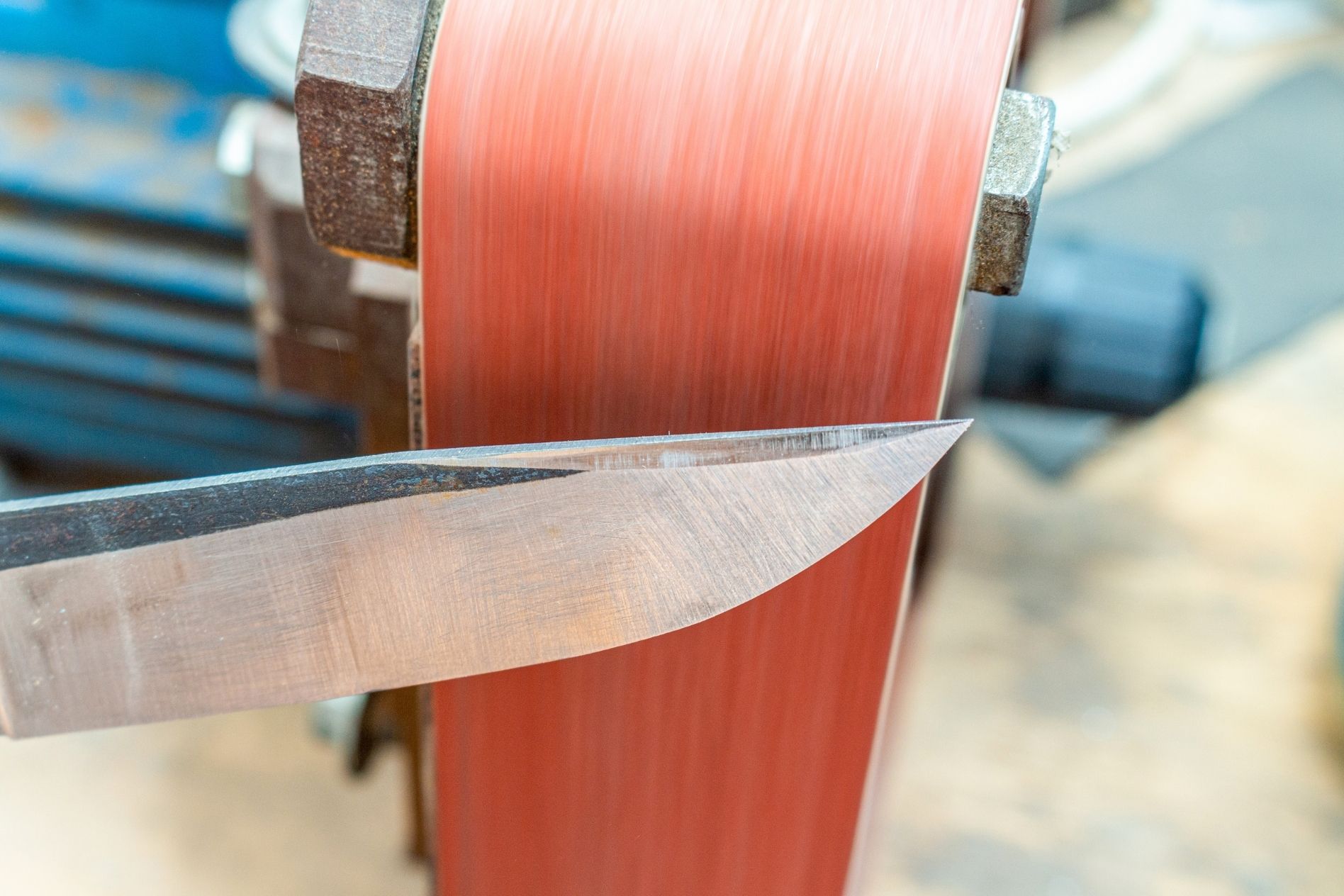 Functional Aspects of Knife Design
And now, we’re on the home stretch! Balance, weight, and knife edge geometry:
Balance and Weight Distribution
For survival and outdoor knives, proper balance is essential for control, efficiency, and fatigue reduction during prolonged use. Unlike kitchen knives, these tools are expected to perform both fine and heavy-duty work — carving feather sticks one moment, and batoning through wood the next.
An ideal balance point for such knives is typically just in front of the handle or near the bolster area, offering a compromise between chopping power and precision control. A slightly blade-forward balance helps with chopping, while a neutral or handle-biased balance gives better handling for carving and slicing.
Weight also plays a significant role. A knife that is too light may lack the force needed for wood processing, while an overly heavy one can tire the user quickly. Full-tang construction not only enhances durability but also contributes to a more stable and predictable weight distribution.
Edge Geometry and Sharpness
The blade geometry of a survival knife must support both cutting efficiency and structural durability. Unlike kitchen knives where slicing performance dominates, outdoor knives require a more robust edge that can withstand impacts and resist chipping.
Common edge grinds include:
- Scandi grind – favored in bushcraft for its ease of sharpening and excellent control in wood carving.
- Flat grind – offers good all-around cutting performance but may be less resilient during heavy use.
- Convex grind – provides superior edge strength and is well-suited for chopping and batoning, though it can be more challenging to maintain.
Sharpness is important, but in survival scenarios, edge retention and durability often take precedence over razor-like sharpness. Sharpening angles typically range from 20° to 25° per side, providing a balance between edge retention and cutting performance.
Conclusion
And there you have it! Of course, this is just the tip of the iceberg— the basics. But the key is to start small and gradually dive deeper into the craft. Who knows, maybe one day you’ll design a knife so perfect that Ray Laconico and Ben Petersen will be nervously smoking off to the side! And even if not, the more you know about knives, the better. Don’t forget to check out our online store— there’s a treasure trove of amazing blades at great prices waiting for you! Until our next thrilling adventure!